




 Prof. Dr. Necdet Sağlam




 Evren Özmen
Serbest Muhasebeci Mali Müşavir
Bilirkişi
evrenozmen@ozmconsultancy.com
www.ozmconsultancy.com

Turkey's 20-Year Foreign Income Tax Exemption - Article 20/D (Who Qualifies and How to Apply?)
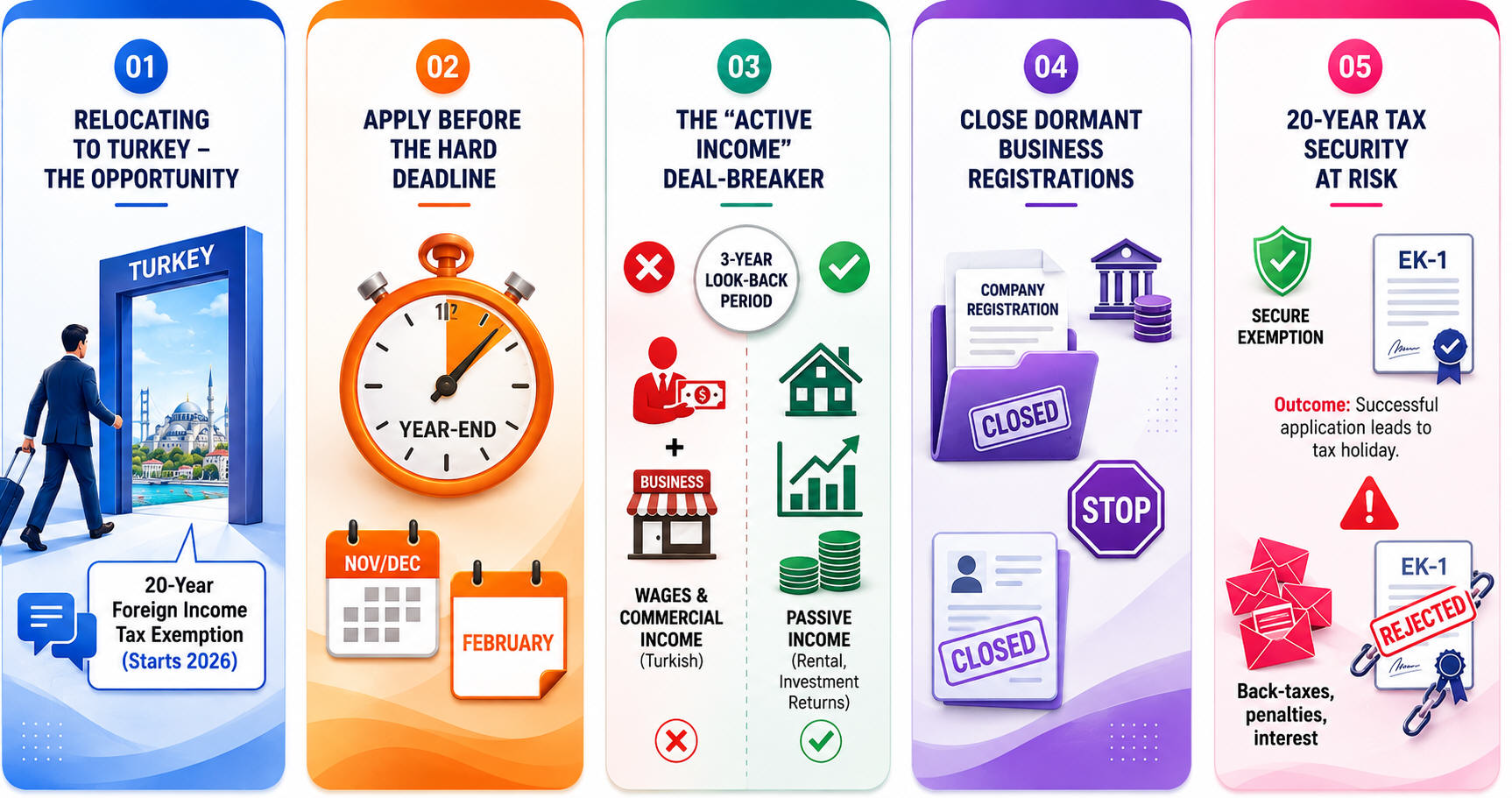
Quick answer: Turkey's 20-year foreign income exemption (GVK Mükerrer 20/D) requires an EK-1 Exemption Certificate, not automatic status. Under Income Tax General Communiqué No. 333, applications are refused if the applicant had Turkish wage or business income during the three-year look-back, or filed after the year-end deadline. Prior Turkish rental, investment, or capital-gain tax liability does not disqualify.
|
Key fact |
Detail |
|
Legal basis |
Law No. 7582, GVK Mükerrer Art. 20/D (RG 4 June 2026, No. 33270) |
|
Implementing rules |
Income Tax General Communiqué No. 333 (RG 4 July 2026, No. 33300) |
|
Who qualifies |
Individuals (not companies) becoming Turkish tax resident from 1 Jan 2026 |
|
Core condition |
No Turkish domicile or tax liability in the 3 calendar years before residence |
|
Approval mechanism |
EK-1 Exemption Certificate — application required, not automatic |
|
Application deadline |
End of the year of residence (end of following February for last-two-months arrivals) |
|
Most common rejection cause |
Dormant/unclosed Turkish commercial registration (example 7) |
Turkey's 20-year foreign income tax exemption under repeated Article 20/D of Income Tax Law No. 193 — introduced by Law No. 7582 (Official Gazette, 4 June 2026, No. 33270) and implemented through Income Tax General Communiqué No. 333 (Official Gazette, 4 July 2026, No. 33300) — has been widely reported as a straightforward 20-year tax holiday for anyone who moves to Turkey. It is not automatic. The exemption depends on obtaining an Annex-1 (EK-1) Exemption Certificate from the tax office, and the certificate can be refused. This article sets out, based on the Communiqué's own worked examples, the specific situations that cause rejection, the situations that are commonly mistaken for disqualifying facts but are not, and the procedural deadline that Communiqué 333 treats as strict.
The Certificate Is Not a Formality
Individuals who become Turkish tax residents from 1 January 2026 onward, and who had neither a registered domicile (ikametgah) nor Turkish tax liability during the three calendar years immediately preceding the year they are deemed resident, may exempt their foreign-source income and gains from Turkish income tax for 20 years. No annual return is filed for the exempt income. Foreign tax paid on that income cannot be credited against Turkish tax, and related expenses cannot be deducted.
None of this applies automatically. The taxpayer must apply to the competent tax office and obtain the EK-1 certificate. Communiqué 333 sets out both the deadline for that application and, through its worked examples, the fact patterns the tax administration treats as disqualifying.
Reason 1: Missing the Application Deadline
Communiqué 333, Article 3(4) fixes the application window as the end of the calendar year in which the individual is deemed resident. For individuals who become resident during the last two months of the year, the deadline is extended to the end of February of the following year.
The Communiqué's own Example 2 addresses a late application directly and confirms that a certificate request filed after this window is refused. There is no discretionary extension built into the text. An applicant who becomes tax resident in, say, March and only files for the certificate the following spring — after focusing first on residence permits, address registration, or business setup — will find the window has already closed for that tax year.
Practical point: the EK-1 application should be treated as a same-year administrative task, not something to revisit once the rest of the relocation has settled down.
Reason 2: Turkish Wage Income in the Look-Back Period
Communiqué 333's Example 6 addresses an individual who had Turkish employment income during the three-year look-back period. This is treated as disqualifying Turkish tax liability. An individual who worked for a Turkish employer — even briefly, even years before the intended relocation date — falls outside the three-year clean period if that employment fell inside the relevant window.
This matters most for two groups: Turkish citizens who worked in Turkey before emigrating and are now returning, and foreign nationals who had a short prior stint of employment in Turkey (for example, a secondment or an earlier failed relocation attempt) that they may not think to mention during an eligibility review.
Reason 3: Turkish Commercial Activity (Ticari Kazanç) in the Look-Back Period
Example 7 addresses a taxpayer with commercial income (ticari kazanç) registered in Turkey during the look-back period. Like Turkish wage income, this constitutes disqualifying tax liability.
In practice, this is the most common and the most avoidable rejection reason encountered in relocation cases: an individual who, years earlier, opened a şahıs şirketi (sole proprietorship) or otherwise registered commercial activity in Turkey and never formally terminated (terk) that registration. The registration can remain open in the tax office's records long after the person stopped any actual activity and left the country. From the tax administration's perspective, the mükellefiyet is still active — and an active commercial registration inside the three-year window blocks the exemption, regardless of whether any real business was conducted.
A second, related trap is a Turkish address record (ikametgah/adres kaydı) that was never updated after departure. Even without commercial activity, a domicile record still showing a Turkish address during the look-back period can be read against the applicant.
Practical point: anyone with any past Turkish commercial registration or address history should pull their own kayıt dökümü (registration history) from the tax office before relocating — not after — and formally close any dormant registration and update the address record if the underlying facts support it.
Example 5 vs. Example 6/7: Passive Income vs. Active Income in the Look-Back
Communiqué 333's example 5 is the mirror image of Reasons 2 and 3 above, and it is frequently misunderstood in the opposite direction: applicants sometimes assume any past Turkish tax filing at all is disqualifying, and delay or abandon an application that would in fact succeed.
Example 5 confirms that prior Turkish tax liability for real estate rental income (GMSİ), income from movable capital (MSİ), or a capital gain (değer artış kazancı) during the look-back period does not, by itself, block eligibility. A person who owned a Turkish rental property, received Turkish-sourced investment income, or sold a Turkish asset during the three-year window before relocation is not automatically excluded on that basis.
This distinction — passive-source tax liability does not disqualify, active-source tax liability (wage or commercial) does — is the dividing line the Communiqué actually draws. It is a narrower disqualification rule than most general descriptions of the regime suggest, and it deserves more attention than it usually receives.
Why This Matters More for the Turkish Diaspora Than for New Arrivals
Foreign nationals who have never previously lived or worked in Turkey typically have no look-back exposure at all. The rejection risk concentrates heavily on two groups already familiar to Turkish tax practice: Turkish citizens returning after years abroad, and long-term expatriates who had an earlier, shorter period of Turkish residence or registration. Both groups are more likely to have a dormant registration, an outdated address record, or a short-lived employment history sitting in the tax office's files — facts the individual may consider irrelevant but which the Communiqué's own examples treat as central to the eligibility test.
Summary Table
|
Fact pattern in the 3-year look-back |
Effect on EK-1 eligibility |
Communiqué 333 reference |
|
Turkish wage income |
Disqualifying |
Example 6 |
|
Turkish commercial income (ticari kazanç) |
Disqualifying |
Example 7 |
|
Application filed after the deadline |
Refused |
Md.3(4), Example 2 |
|
Rental income (GMSİ) |
Not disqualifying |
Example 5 |
|
Investment income (MSİ) |
Not disqualifying |
Example 5 |
|
Capital gain (değer artış kazancı) |
Not disqualifying |
Example 5 |
What Happens If the Certificate Is Refused or Later Found Invalid?
If the tax administration later determines that the conditions were not actually met — for example, an undisclosed prior commercial registration comes to light — the tax that would otherwise have applied to the foreign-source income is assessed as a tax loss (vergi ziyaı), together with the related penalty and default interest under the Communiqué's enforcement provisions. This is a materially worse outcome than simply being ineligible from the outset, because it can surface years into the 20-year period, after income has already been treated as exempt.
Case Notes
The following examples are anonymized composites based on common fact patterns encountered in practice. They do not describe any identifiable individual.
Case 1 — the dormant registration. A Turkish citizen who had lived and worked in Germany for eight years returned to Turkey and applied for the EK-1 certificate. The application was refused. The reason surfaced only during the review: a şahıs şirketi opened in 2016, before the individual first moved abroad, had never been formally terminated. The registration had no activity for years, but it was still open in the tax office's records — which placed disqualifying commercial income (ticari kazanç) inside the three-year look-back under the same logic as Example 7. The registration was later closed, but the closure came too late to affect the year in which residence was established.
Case 2 — the missed deadline. A UK national relocated to Turkey in May 2026 and spent the following months on the residence permit, a lease, and setting up a local bank account. The EK-1 application was filed the following April, once the rest of the relocation had settled. Under Communiqué 333, Article 3(4), the deadline for a mid-year arrival is the end of the same calendar year — so the application was already several months late by the time it was filed. It was refused on timing alone, independent of whether the underlying income would otherwise have qualified.
Case 3 — the false alarm. An investor who had owned a rental apartment in Istanbul for several years, and had filed Turkish returns reporting the rental income (GMSİ) throughout that period, assumed this prior filing history would disqualify a future application and delayed relocating for nearly a year on that assumption. Under Example 5, rental income during the look-back period does not block eligibility. Once the facts were reviewed, the application proceeded on the original timeline with no issue.
Frequently Asked Questions
Can I fix a dormant Turkish business registration before I apply?
Yes, and this should generally be done before relocating rather than after. Formally terminating (terk) an inactive registration removes it as a live issue, but the timing and documentation should be reviewed with a professional before the move, since the look-back period is measured from the year of relocation.
Does having filed a Turkish tax return at all in the past three years disqualify me?
Not automatically. It depends on what the return covered. A return reporting only rental income, investment income, or a capital gain does not disqualify under Example 5. A return reporting wage income or commercial income does, under Example 6 and Example 7.
What if I miss the year-end deadline?
Communiqué 333 treats the deadline as strict, subject only to the extended end-of-February window for individuals who become resident in the last two months of the year. There is no general late-filing allowance in the current text.
Is the three-year look-back based on calendar years or a rolling 36-month period?
It is based on full calendar years — the three calendar years immediately preceding the year in which the individual is deemed resident.
Does this apply to companies?
No. The exemption under Article 20/D applies to natural persons only.
Should I check my own tax office records before assuming I qualify?
Yes. A kayıt dökümü (registration and liability history) from the tax office is the only reliable way to confirm whether a past registration or address record is still open.
Conclusion
Turkey's 20-year foreign income exemption is a genuine and unusually generous regime by international standards, but the EK-1 certificate is a real administrative gate, not a formality. The two most common causes of rejection — a dormant commercial registration and an outdated Turkish address record — are also the two most preventable, provided they are identified before the relocation date rather than after the application is filed.
Sources and Legal References
- Law No. 7582, Official Gazette 4 June 2026, No. 33270 (adding repeated Article 20/D to Income Tax Law No. 193)
- Income Tax General Communiqué No. 333, Official Gazette 4 July 2026, No. 33300, Article 3(4) and Örnek 2, 5, 6, 7
- Income Tax Law No. 193
10.08.2026
Kaynak: www.MuhasebeTR.com
(Telif Uyarısı: Bu makalenin en fazla %20'si, kaynak gösterilip aktif link verilerek paylaşılabilir. Aksi takdirde yasal işlem başlatılacaktır.)



>> Duyurulardan haberdar olmak için E-Posta Listemize kayıt olun.
>> SGK Teşvikleri (150 Sayfa) Ücretsiz E-Kitap: hemen indir.
>> MuhasebeTR mobil uygulamasını Apple Store 'dan hemen indir.
>> MuhasebeTR mobil uygulamasını Google Play 'den hemen indir.
>> Muhasebecilere Özel Web Sitesi 1.250 TL Ayrıntılar için tıklayın.
 Asgari Ücret 2026 - Asgari Ücret Ne Kadar?
 Vergi Dilimleri 2026
 Facebook
 Twitter
 Linkedin
 Google+
 Whatsapp
 E-posta
 Yazdır
-
 Bağımsız Denetime Tabi Olmayan Çokuluslu Şirketler İçin Pillar 2 ve TFRS Dönüşüm Gerekliliği
-
 YENİ BAŞLAYANLAR İÇİN MUHASEBE EL KİTABI ÇIKTI
-
 İndirilemeyen KDV Uygulamasında Kontrol Sürecine Farklı Bir Bakış
-
 102 Bankalar Hesabının Muhasebeleştirilmesi, Denetimi ve Banka Mutabakatı
-
 Bağımsız Denetimin Kısıtları, Sıkıntıları ve Alınabilecek Tedbirler
-
 Ortak Çıktı, Şirket Payını Geri Aldı... Peki Sonra?
-
 Anahtar teslim suretiyle verilen işlerde SGK işlemleri
-
 Kısmi süreli çalışanların SGK gün sayısı nasıl hesaplanır?
-
 3 Konu 3 Karar (Yıllık İzin, Sosyal Medya Paylaşımları ve İşten Çıkış Kodları)
-
 Ortaklar Sözleşmesi (SHA) Nedir? Girişimcilerin Gözden Kaçırmaması Gereken Kritik Hükümler
-
 Limanlara Bağlantı Sağlayan Demiryolu Hatları ile Liman ve Hava Meydanlarının İnşası, Yenilenmesi ve Genişletilmesine İlişkin İstisna
-
 Muhasebecilere Özel Web Sitesi 1.250 TL